

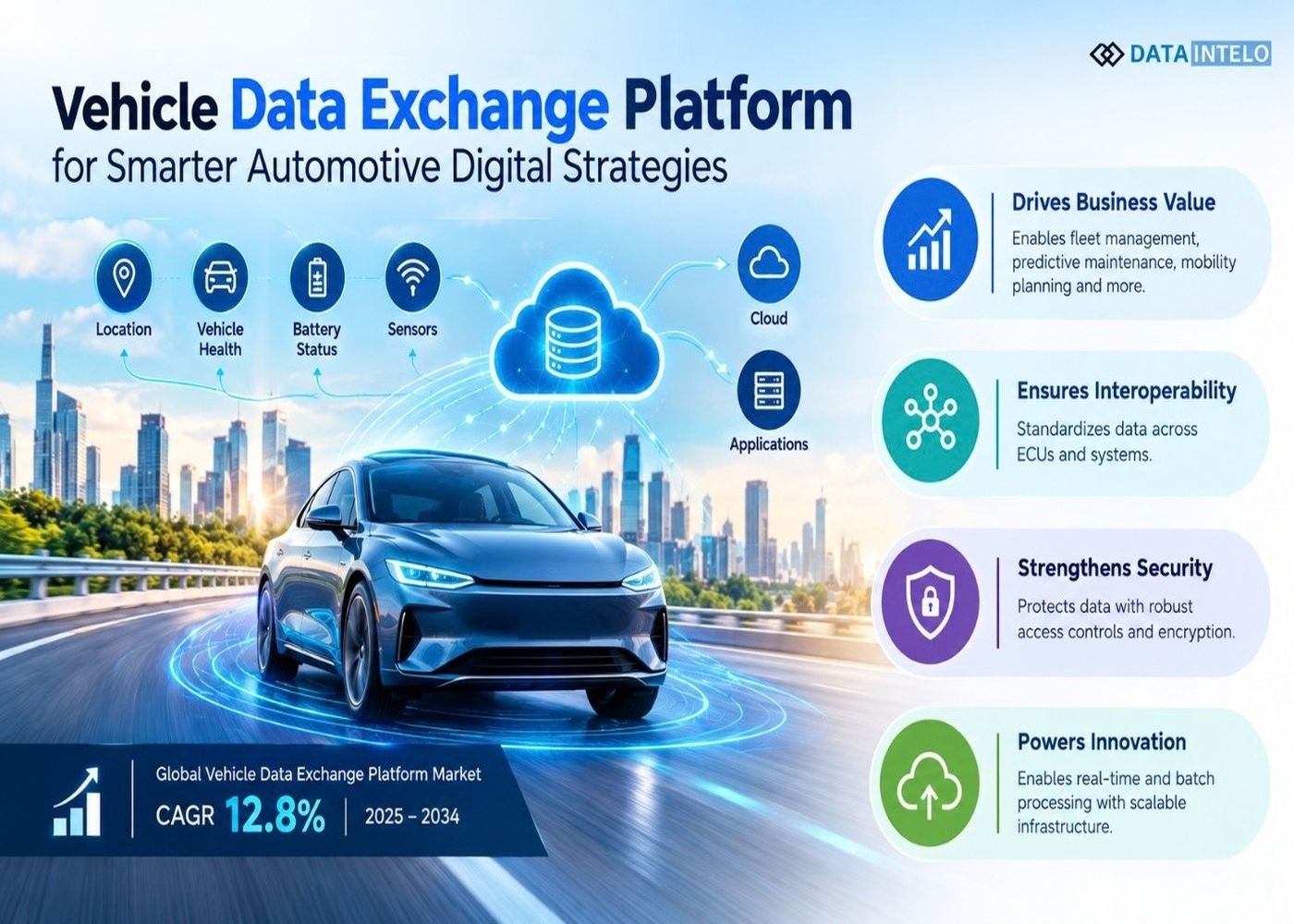
Modern cars are becoming digital ecosystems that gather
information using various kinds of sensors, GPS units, electronic control
units, batteries, and infotainment systems. This information can help with the
analysis of vehicle performance, position, energy consumption, driver
behaviour, and road conditions. Taking into account projections for the number
of connected cars to reach 400 million in 2025, it is necessary to think of a
way to deal with large amounts of incoming information in an appropriate way.
A vehicle data exchange solution enables secure data
collection, standardization, and dissemination among automotive systems. This
leads to valuable applications like fleet management, predictive maintenance,
mobility planning, insurance analytics, and charging management.
From Raw Signals to Usable Vehicle Data
A connected vehicle can generate data at varying intervals,
ranging from milliseconds for safety messages to minutes for maintenance
information. Some of the data that may be generated consists of speed,
acceleration, braking behavior, battery status, tire pressure, location, energy
consumption, errors, and component temperature data. A platform must achieve
conversion from various automobile architectures and communication protocols to
a unified data format.
Research conducted in 2025 examined communication stages,
datasets, and application requirements, highlighting the importance of
interoperability. Standardized exchange can make data usable across fleet management,
maintenance, insurance, mobility, and infrastructure.
Why Interoperability Matters
Automotive data comes from numerous electronic control
units. Different manufacturers may use different naming conventions, formats,
update intervals, and access controls. A data exchange platform can create a
common interface between these systems.
Automotive data communication standards currently cover
areas such as vehicle diagnostics, in-vehicle networks, extended-vehicle
communication, and sensor data interfaces. This reflects a practical issue:
data cannot support cross-industry strategies efficiently when systems
interpret the same signal differently.
Data Exchange and Digital Strategy
Vehicle data becomes more useful when it moves quickly from
collection to analysis. A fleet platform may process location data every few
seconds, while predictive maintenance models may combine diagnostic readings
collected over hours or days. A shared exchange layer lets applications access
the required detail without rebuilding the data pipeline.
As per the analysis conducted by Dataintelo, the
international market for vehicle data exchange platforms is expected to garner a valuation of 14.2 billion US
dollars in 2025 and reach 38.7 billion US dollars by 2034, thereby ensuring
a sound CAGR rate of 12.8% throughout the projection period.
This market’s expansion is attributed to the increasing
adoption of connected cars, telematics, analytics and software-oriented vehicle
technologies. Along with the rising number of cars that produce continuous
data, businesses find it necessary to search for feasible solutions for the
exchange of data between the vehicles, the cloud, applications and outside services.
Key Data Streams Supporting Automotive Applications
A vehicle data exchange platform can organize multiple
information streams, with each serving a different digital application. The
type, frequency, and volume of data can vary considerably.
|
Data stream |
Typical information |
Example frequency |
Digital application |
|
Telematics |
Location, speed, distance |
1–30 seconds |
Fleet monitoring |
|
Diagnostics |
Fault codes, temperature |
1–60 minutes |
Predictive maintenance |
|
Battery |
State of charge, energy use |
1–10 seconds |
Charging management |
|
Driving behaviour |
Braking, acceleration |
1–5 seconds |
Safety analytics |
|
Road environment |
Traffic, weather, road conditions |
10–60 seconds |
Mobility planning |
The data provided by telematics can help in fleet decisions
in quasi-real-time, as opposed to the traditional diagnostics records that are
based on historical data. Battery parameters of electric automobiles have
started to be of great importance because charging and electric consumption are
helpful for estimating autonomous driving distance and optimizing charging.
Security, Consent, and Data Quality
Determinism arising from enhanced data transfers imposes new
duties regarding access management and securing data. The automotive domain
presents new demands for authentication, encryption, access control, auditing,
and properly constructed consent mechanisms. Security evaluations have shown
gaps in network communications between vehicles and within the vehicle architecture
itself, and secure data communication is an integral feature.
Quality of data is of importance too. A feed from a location tracker with a 30 sec delay can serve the purpose of historical analysis, but not for real-time applications. A feed with no timestamps or inconsistent units will lead to errors in the analysis. Validation rules for input, metadata, and standardized schemas become important components of exchange architecture.
New Research and Emerging Applications
The recent studies have moved from traditional telemetry to
collaborative and advanced predictive uses. Research regarding connected cars
includes principles of cooperative perception and communication, databases, and
platforms that show how data is being used by vehicles in connection with
infrastructure.
Connected car data offers a wide range of commercial and
other uses as well, including insurance, fleet management, predictive
maintenance, mobility analytics, and smart cities. All of these applications
would require the integration of vehicle data with other information without a
separate data channel for each case.
As vehicle systems move increasingly toward software-based
environments, exchange platforms will also enable the development of new
applications and designs without affecting the vehicle architecture itself. The
adaptability of this technology gives organizations the opportunity to
introduce analytic, monitoring, and movement solutions as needs change.
What a Mature Exchange Platform Needs
A practical platform depends on five capabilities:
- Standardized data models that make information consistent
across sources.
- API-based access that allows applications to retrieve
relevant datasets efficiently.
- Real-time and batch processing for operational requirements.
- Privacy and cybersecurity controls covering identity,
permissions, and transmission.
- Data governance covering quality, retention, ownership,
consent, and auditability.
These capabilities separate data collection from application
development. A new analytics application can use an existing exchange layer
instead of creating an independent connection to every vehicle or manufacturer
system.
The Road Ahead
The automotive digital ecosystem is increasingly relying on
vehicle data exchange as vehicles are generating ever more connected,
software-intensive data. By 2030, it is expected that close to 95% of cars sold
will be connected, whereas around 50% of cars were expected to be connected in
2020. The trends suggest that large volumes of various data will be generated.
The next level will imply interoperability of systems,
analytics that protect data privacy, standardized APIs, and faster processing
among vehicles, clouds, and service providers. Therefore, vehicle data exchange
systems are not only about transferring data but also about forming a platform
where all relevant data can be analyzed, managed, and utilized.
Trending Posts
-
 Vehicle Data Exchange Platform for..Sep 29, 2026