

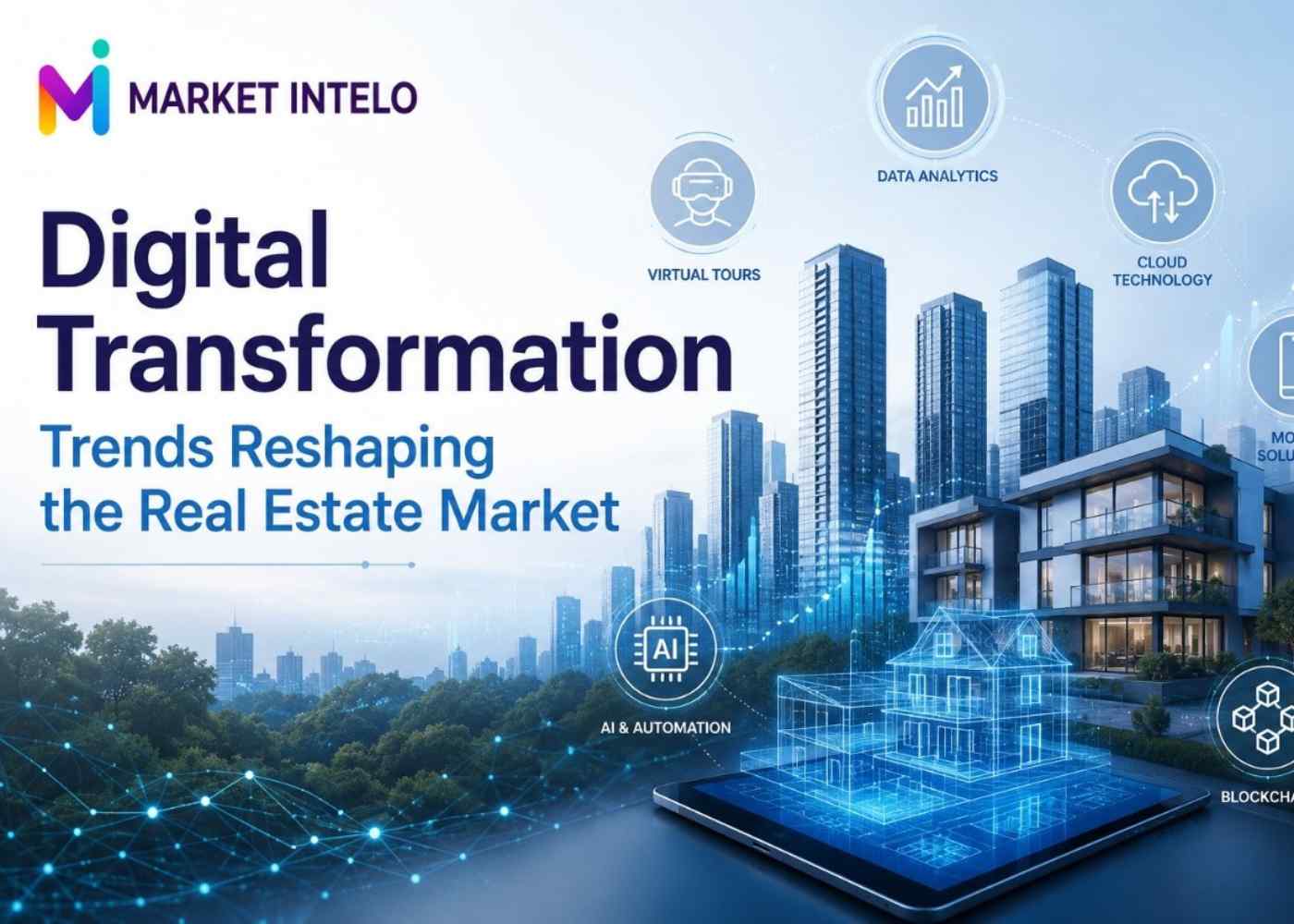
The real estate sector is redefining its structure as modern
technology morphs into a critical aspect of value creation, risk control, and
customer interaction. The emergence of PropTech systems, AI, data analysis, and
other digital business ideas is changing how developers, investors, occupants,
and brokers work in the sectors of residential, commercial, and industrial
properties. The paper analyzes key trends in digital transformation and new
developments that lead to the changes in the real estate industry worldwide.
According to MarketIntelo, In the year 2025, the global real estate market
value stood at $4,892.6 billion, and it is expected to grow at a compound
annual growth rate (CAGR) of 5.9% during the period until 2034, reaching a
total value of $8,214.3 billion.
The Rise of Proptech and Digital Platforms
The evolution of Proptech goes back to the time it was
merely an aggregator of listings to now becoming a vast network of platforms,
which offer services from property searches to transactions of assets. Our
contemporary systems are usually hosted on cloud platforms and add-ons of mobile
devices. Digital services provide opportunities for users to cater to every
transit from signing up for a digital platform to home tours.
Today, such solutions, as Proptech are relied on to complete
the entire process of a transaction, from the time buyer presents his or her
needs and preferences to the funding of the deal. Therefore, friction in the
process of property transactions is decreased considerably no matter whether it
is a residential or commercial property.
Data, AI, and Predictive Analytics
Due to the digitization and convergence of market, asset,
and user information, real estate is evolving into a field that relies heavily
on data. Businesses are applying AI and big data to improve their underwriting,
pricing, portfolio management, and tenant relationships.
Specific cases of usage involve the automated valuation
model, demand forecasting based on machine learning, and recruitment
applications powered by AI. Real estate companies employ these solutions to
achieve higher accuracy in risk evaluation, conduct fewer manual operations,
and make decisions faster in environments where information used to flow slowly
and chaotically.
Virtual and Immersive Property Experiences
The usage of virtual tours, 3D walkthroughs, and augmented
reality (AR) technologies is the norm in the property marketing and valuation
process. More and more buyers and tenants perform thorough inspections
remotely, analyze layouts, and visualize the interior without visiting a number
of physical places.
For landlords and developers, these powerful tools increase
reach, cut their marketing expenses, and speed up decision-making of the
clients on the local and overseas markets.
Smart Buildings and Operational Technology
Smart buildings lie in the overlap between real estate and
operational technology. Building systems for heating, ventilation, air
conditioning, lighting and access control, and energy management can
communicate with each other thanks to the use of sensors, IoT devices, and
integrated building management software.
This makes it possible to monitor different processes and
use automated control technology to perform predictive maintenance. Building
owners will be able to lower operational costs, improve comfort for occupants
and reach their sustainability goals, while investors and lenders will have
access to previously unavailable operational data regarding the performance of
the asset in terms of resilience and ESG qualifications.
Blockchain, Tokenization, and Digital Transactions
Blockchain technology and tokenization are becoming
prominent technologies in the digital movement of the real estate industry. The
distributed ledger technology guarantees reliable, transparent, and
incorruptible documentation of ownership and deal history, thus facilitating
speedier procedures like deed transfers, handling of escrows, and compliance
checks.
Tokenization enables partial ownership of physical assets by
converting the property interest into a digital token. This may lead to
increased investment opportunities in real estate as minimum investments get
lowered and secondary trade becomes possible. In spite of the fact that no
proper regulatory frameworks are available yet, there is a clear tendency of
rising interest among institutional and alternative investors as evidenced by
some successful pilot projects in real estate sectors, such as commercial real
estate and hospitality.
New Business Models and Digital Revenue Streams
The implementation of digital transformation is resulting in
the creation of novel business models that surpass the standard practices
involved in leasing and sales operations. For instance, flexible workspace
platforms, subscription-based living arrangements, and data-driven asset
management services that enable monetization of operational insights.
Operators and owners are integrating digital services, such
as smart access, tenant experience applications, integrated payment solutions,
and amenities booking systems. These services are useful in identifying
properties, establishing a price that is too high, and allowing for the
retention of tenants. It is interesting to notice that at the same time, institutional investors and large operators are currently creating integrated
platforms that combine development, digital services, and operations.
Regional Developments and Policy Drivers
Digital transformation in the real estate industry is
happening at different rates across the globe. For instance, in advanced
markets, people are more concerned about advanced analytics, customer-oriented
digital platforms, and a combination of digital identity, e-signatures, and open
data projects. They are mostly focused on the automation of processes and the improvement of customer experience.
As for developing markets, they prioritize basic
digitization, such as transition to digital land registries, transaction
processes standardization, and access to digital property and real estate
marketplaces. Various government programs focused on smart cities, low-cost
housing, and urban infrastructure also facilitate the use of digital technologies
in planning, permitting, and property management.
|
Region |
Market Share (2025) |
Market Value (2025) |
Forecast CAGR (2026–2034) |
Estimated Market Value (2034) |
Key Digital Transformation Trend |
|
Asia Pacific |
37.1% |
USD 1,813.3 Billion |
6.4% |
USD 3,169.0 Billion |
AI-powered property search, smart-city development,
digital land records, and PropTech-led transaction platforms |
|
North America |
28.4% |
USD 1,389.5 Billion |
5.6% |
USD 2,270.5 Billion |
Automated valuation models, virtual property tours,
digital mortgage platforms, and data-center real estate expansion |
|
Europe |
22.3% |
USD 1,091.0 Billion |
5.9%* |
USD 1,831.3 Billion |
ESG building analytics, smart-building retrofits, digital
leasing, and portfolio-management software |
|
Latin America |
7.3% |
USD 357.1 Billion |
5.9%* |
USD 599.5 Billion |
Online property marketplaces, digital payments,
mobile-first brokerage, and PropTech-enabled housing access |
|
Middle East & Africa |
4.9% |
USD 239.7 Billion |
7.2% |
USD 447.9 Billion |
Smart-city mega-projects, blockchain-supported property registration,
digital twins, and AI-enabled facility management |
|
Global Market |
100.0% |
USD 4,892.6 Billion |
5.9% |
USD 8,214.3 Billion |
Digital platforms, AI valuation, virtual tours, automated
lease workflows, and data-led investment decisions |
*Estimated using the global market CAGR because the report
page provides specific regional CAGR figures
Market Outlook and Growth Drivers
The future of digital transformation in the field of real
estate presents favorable prospects. The urge for digital-centric experience
among tenants and buyers, increasing operating costs and energy pressure, and
the need for transparent and data-driven assets for investors build up the
case for technology application in this field. Moreover, as proptech develops,
the sector is going to witness consolidation among platforms that integrate
processes, data, and various participants during the lifecycle of an asset.
Companies that are going to invest in expandable technology capabilities,
effective management of data, as well as a clearly defined technology path, are
going to benefit from increased productivity.
Strategic Considerations for Industry Stakeholders
Digital transformation is now mandatory for developers,
property owners, and investors. This implies that the main areas of interest
include ensuring interoperability of the data architecture, effective
integration of the platform into existing systems, and alignment between the
investments in IT and business goals like occupancy levels, returns on
investment, and operating costs.
At the same time, human and organizational aspects have the
same importance in digital transformations. To achieve success, training of
teams, adaptation of operational models, and cooperation of stakeholders from
various domains are necessary.
Reference: https://marketintelo.com/report/real-estate-market
Trending Posts
-
 Digital Transformation Trends..Jul 10, 2026
 -
How to Get a Mortgage for Investment..Aug 30, 2025
-
3D Printing and Sustainable..May 24, 2025

