In an already fast-digitizing economy, the influx of social
media into Nigeria has fundamentally changed, not just how individuals
communicate, but the ways in which brands can market to, build trust with and
influence consumers. For instance, as of January 2025, DataReportal estimates
that there are more than 38 million active social media users in Nigeria, who
constitute about 17% of the country’s population. This digital explosion has
proven particularly beneficial to two of the largest marketing beasts,
Influencers and KOLs.
Although the two are often used interchangeably within the
Nigerian digital ecosystem, the distinction between a KOL and an influencer is
not simply semantic. It represents a distinction of subtler gradations of
trust, authority, connection, and brand strategy alignments that marketers
would do well to heed.
Given that Nigerian brands are spending billions on
influencer marketing and brand collaborations annually, differentiating KOL vs.
influencer in Nigeria is vital to help develop effective campaigns that will
yield ROI. While Statista predicts that Nigeria’s influencer marketing industry
will exceed N50b by 2026, only a few brands are leveraging impact by
strategically collaborating with KOLs.
We will unpack the definitions, distinctions, functions, and
importance of both KOLs and influencers in Nigeria in this blog post so that
marketers and brand strategists can have a data-driven perspective from which
to improve their digital marketing in Nigeria.

Understanding the Key Players: KOLs and Influencers in Nigeria
Who is a KOL in Nigeria?
A Nigerian Key Opinion Leader (KOL) is an individual with
subject matter expertise and authority, a dedicated following, and influence
based more on established credentials, trust and expertise than by
entertainment or aesthetics alone.
Examples of Nigerian KOLs include:
- Dr. Ola Brown (Healthcare & Finance)
- Fisayo Fosudo (Tech & Finance)
- Uche Pedro (Media & Lifestyle)
While these individuals might not have millions of
followers, their positions as thought leaders make them invaluable to niche
marketing, particularly within fintech, education, health, and policy in
Nigeria.

Who is an Influencer in Nigeria?
A Nigerian influencer is an individual with a significant online presence who exerts some sway over consumer choice, largely based on lifestyle aspirationality, relatability, and/or the aesthetics of their content. They’re not necessarily industry experts, but they have influence and reach, particularly among Gen Z and millennials.
Some recent popular Nigerian influencers include:
- Papaya Ex (Lifestyle & Fashion)
- Sydney Talker (Entertainment & Comedy)
- Dimma Umeh (Beauty & Skincare)
They are pervasive on Instagram, TikTok, and YouTube, and
they are central to social media marketing in Nigeria, especially for consumer
goods and entertainment.
KOL vs Influencer in Nigeria: Key Differences That Matter
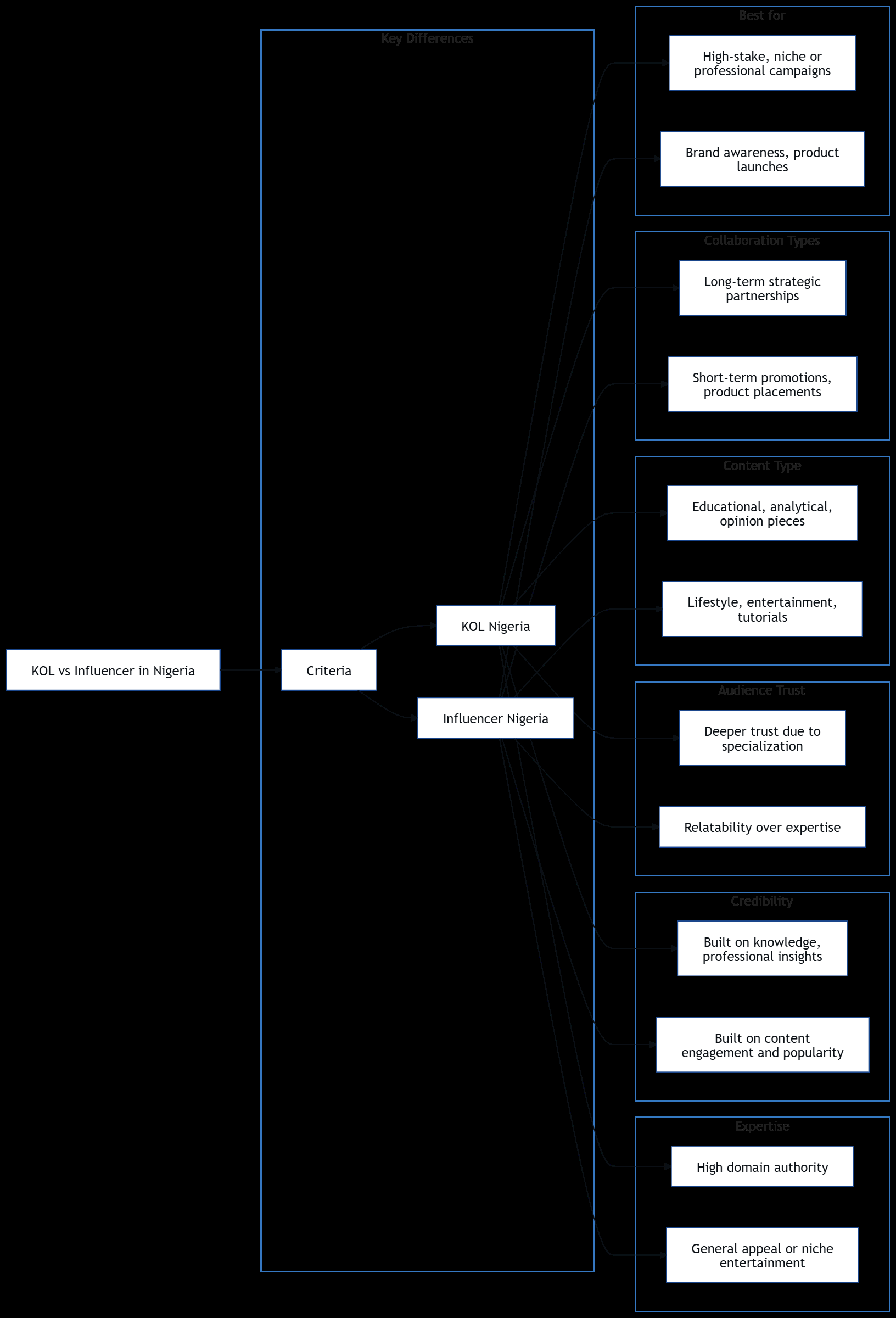
Why Nigerian Marketers Must Distinguish Between KOLs and
Influencers
1. Poor Alignment Results in Wasteful Spend
A 2024 report from Nigerian Digital Marketing Insights found
that over 48% of brands selected influencers solely based on popularity, and as
a result did not achieve their campaign KPIs due to not selecting influencers whose
audiences matched the target, or whose authorities aligned with the brand’s
values. A fashion influencer working with a health-tech startup on an AI diagnostics campaign may create hype, but not necessarily conversions.
2. Depth via KOLs, Reach via Influencers
The opinion of a KOL can thus have intellectual heft as it
pertains to financial literacy or climate policy; it has the potential to
impact discourse and feeling about policy. Influencers are better suited for
campaigns that require mass appeal, such as the launch of a new mobile phone or
a fashion line. Nigerian marketers must choose between creating for virality or
validation, or both, and create campaigns accordingly.
3. Success is Measured in Various Ways
Success for influencer campaigns is often measured in terms
of reach, impressions, or likes. KOL campaigns, on the other hand, track depth
of engagement, shares of content, mentions of thought leadership, and
backlinks. Tracking things you know you should can help define ROI.
Nigerian Marketing Strategies: When to Use KOLs vs. Influencers
Use KOLs When:
- You’re selling technical products such as SaaS, fintech
tools or pharmaceuticals.
- You are looking for brand credibility and educational
information.
- It addresses an appeal to the mind rather than to the eye of
the audience.
For instance, a company in the business of blockchain-based
solutions for digital currencies, based in Lagos, attempting to access the
policy market would likely be more successful partnering with a KOL such as
Chinwe Egwim, a financial economist, than a popular TikToker.
Use Influencers When:
- You’re in food, fashion, cosmetics, gadgets, or consumer
products.
- You want quick awareness and viral momentum.
- Your campaign is dependent on user contributions or
challenges.
For instance, if the goal is to go viral on TikTok, a new
restaurant in Lagos will be better suited to collaborate with influencers like
Aproko Doctor or Eronini Osinachi rather than a university professor.

Brand Collaboration in Nigeria: Emerging Trends
Hybrid Campaigns Are On the Rise
In Nigeria, clever brands are blending KOLs and influencers
to acquire both depth as well as reach. As an example, a health care startup
could bring in a KOL to theorize the science behind a product and then bring in
an influencer to show how the product can fit into one’s life.
The Rise of Micro-KOLs and Nano-Influencers
The high engagement and community “credibility” of
micro-KOLs, particularly with followers between 1K – 10K and nano-influencers
(with under 1K), are leading brands to put more thought into these types of
influencers. For example, a Paredaim Plus Study in 2024 concluded micro-KOLs in
Nigeria create 2.5x more engagement per post than mega-influencers.

The Future of Influencer Marketing in Nigeria
Given Nigeria’s youthful population as well as the high smartphone penetration, influencer marketing will continue to boom in Nigeria. There is now a more sophisticated audience, but given the digital savvy of Nigerian consumers.
They are asking:
- Does this person have a license to market this?
- Is this a sponsored message, and should I believe it?
= This change is beneficial for KOLs in fields such as
education, finance, law, and health, while influencers are still at the center
of beauty, lifestyle and entertainment.
Also, agencies such as ARCON (Advertising Regulatory Council
of Nigeria) are clamping down on digital influence. When transparency is the
law, and it already is, authenticity trumps aesthetics.

Conclusion
In an increasingly noisy online world, it is no longer
sufficient to engage a celebrity with a large social following. Brands
in Nigeria should begin to strategically consider who influences the audience
they are trying to reach, rather than simply looking at who is popular.
- Nigerian KOLs include authority on the subject matter,
trust, and long-term brand equity.
- Nigerian influencers provide these three key elements:
reach, relatability, and lifestyle.
- The most intelligent Nigerian marketers now effectively
employ either contextual insight, niche segmentation or digital analytics to
bring about results.
Whether you are starting a fintech company or are marketing
skincare, it’s all about finding the right voice for your brand and not being
seduced by high follower numbers.
Paredaim Plus does the heavy lifting for brands by utilizing
sophisticated influencers’ data, segmentations, and campaigns focused on
returns. Get in touch to co-create marketing that connects with meaningful
influence.
Trending Posts
-
 Stop Scope Creep: Price Your Agency..Jul 12, 2026
 -
Effective Digital Campaigns: Case..Apr 25, 2026
-
Digital Transformation Roadmap for..Feb 24, 2026
-
How AI and Deep Linking Redefine..Jan 06, 2026
-
Why Jackie Aina Is a Case Study in..Dec 27, 2025
-
How Ifedayo Built a 1 Million Dollar..Dec 26, 2025